Everyone buys their insurance policy with the hope of never needing to file a claim on it. When your home sustains damages from fire, water, or wind and the time comes to file a claim, it may very well be your first time looking at your policy since you first bought it. One of the most important things to look at is your declarations page, commonly shortened to dec page, which contains important information about your policy period, coverage limits, deductibles, and more.
Your declarations page is almost always the first one to two pages of your policy packet. Think of it like the high-level summary of your entire insurance policy—which can sometimes be up to 100 pages long! Any time your insurance company renews your policy, they should send you a new dec page along with your renewal.
Before filing your claim, here are the key things to look at in your dec page. Let’s look at an example.
(It’s important to note that every insurance company’s dec page looks a little different. All of this information will be there… it may just be in a slightly difference place than on the sample below.)
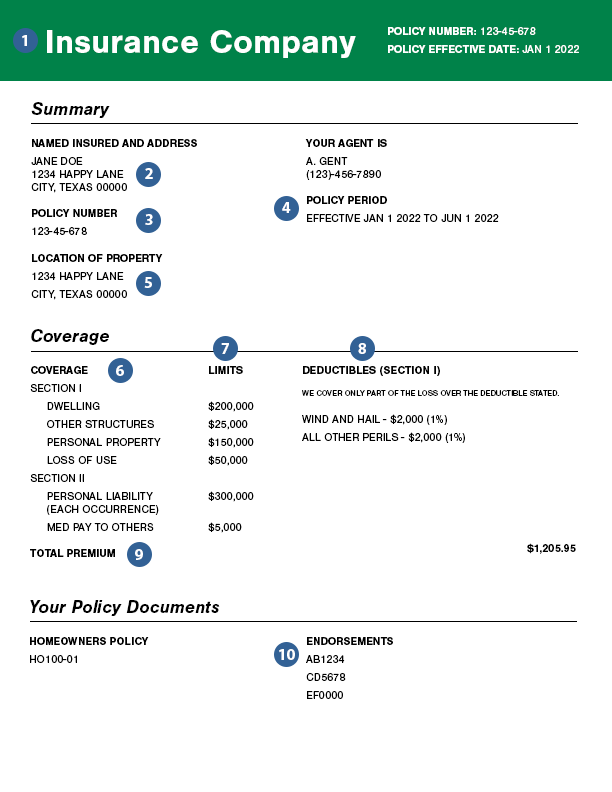
1) Insurance Company: The name of your insurance company. Self-explanatory! This is who you’ll call to file your claim.
2) Named Insured and Address: This confirms the name(s) the policy was purchased under. Typically, only the named insured(s) or the mortgage company can file claims on a property. If you are not named on the policy, you will need to have someone who is named file the claim.
This section also confirms the mailing address that insurance information is sent to. Sometimes it’s the same as your insured address, but it may also be an alternate property that you receive mail at, or even a P.O. box.
3) Policy number: You will be asked to provide your policy number when calling in your claim, so be sure to have it handy. While most policy numbers remain the same year to year, they can occasionally change.
4) Policy period: Also called “effective dates,” these reflect the dates that the policy is active. Policy periods typically last for one year. If the damages to your home occurred before the policy period, don’t panic! You can still file a claim. Just make sure to find the dec page that covers the date of your loss to verify that the policy number is the same.
5) Location of Property: This is the actual physical location covered by the insurance policy. If you own multiple properties, be sure to check that the address here matches the address you are filing a claim for.
6) Coverage: The broad categories of damage covered by your insurance company are listed here. Section I covers the most common categories, so let’s go through those in more detail.
a. Dwelling refers to the interior and exterior of the house itself.
b. Other Structures refers to ADUs, sheds, or garage that are detached from the dwelling. This limit is usually about 10% of the dwelling limit
c. Personal Property refers to the items in your house. Think furniture, electronics, clothes, jewelry, etc.
d. Loss of Use refers to payments the insurance company makes to you in the event that your home becomes uninhabitable, designed to cover living expenses if you have to temporarily find alternate housing. You may also hear this called ALE, or Additional Living Expenses.
7) Limits: This is the absolute most your insurance company will pay for covered damage. Each type of coverage has its own limit.
8) Deductibles: Almost every claim is subject to a deductible, which is the amount you are responsible for paying before your insurance policy actually kicks in. You will never pay a deductible out of pocket; the amount is simply deducted from the payment your insurance company makes to you.
For example, if your policy has a deductible of $2,000 for wind claims, and your insurance company agrees to pay you $20,000 to settle your wind claim, you will receive $18,000 in payment because of the deductible. Unfortunately, deductibles are not negotiable.
Typically, every coverage is subject to its own deductible.
9) Total Premium: This is the amount you pay your insurance company for your insurance policy.
10) Endorsements: Also called riders, endorsements are option policy changes you may have purchased on your insurance policy to give you more coverage.
Filling in the gaps
While your declarations page can give your the basics about your policy, it also doesn’t tell the whole story. Even if you read through your entire insurance policy cover t o cover, you may still walk away with questions like:
Why doesn’t my insurance policy list the specific types of damage it covers?
How does my insurance company differentiate “wear and tear” vs. “sudden and accidental” damage?
What are my options if my insurance company denied my claim?
Fortunately, this is where a Public Adjuster can be a valuable asset. One of the most important parts of my job as a Public Adjuster is to read between the lines of your insurance policy, prove how the damage to your property is covered, and help you secure the settlement you’re owed.
If you’re struggling to understand your policy or facing a claim denied by your insurance company, reach out today for a completely free, no-obligation consultation to review your policy and assess the damage to your property.